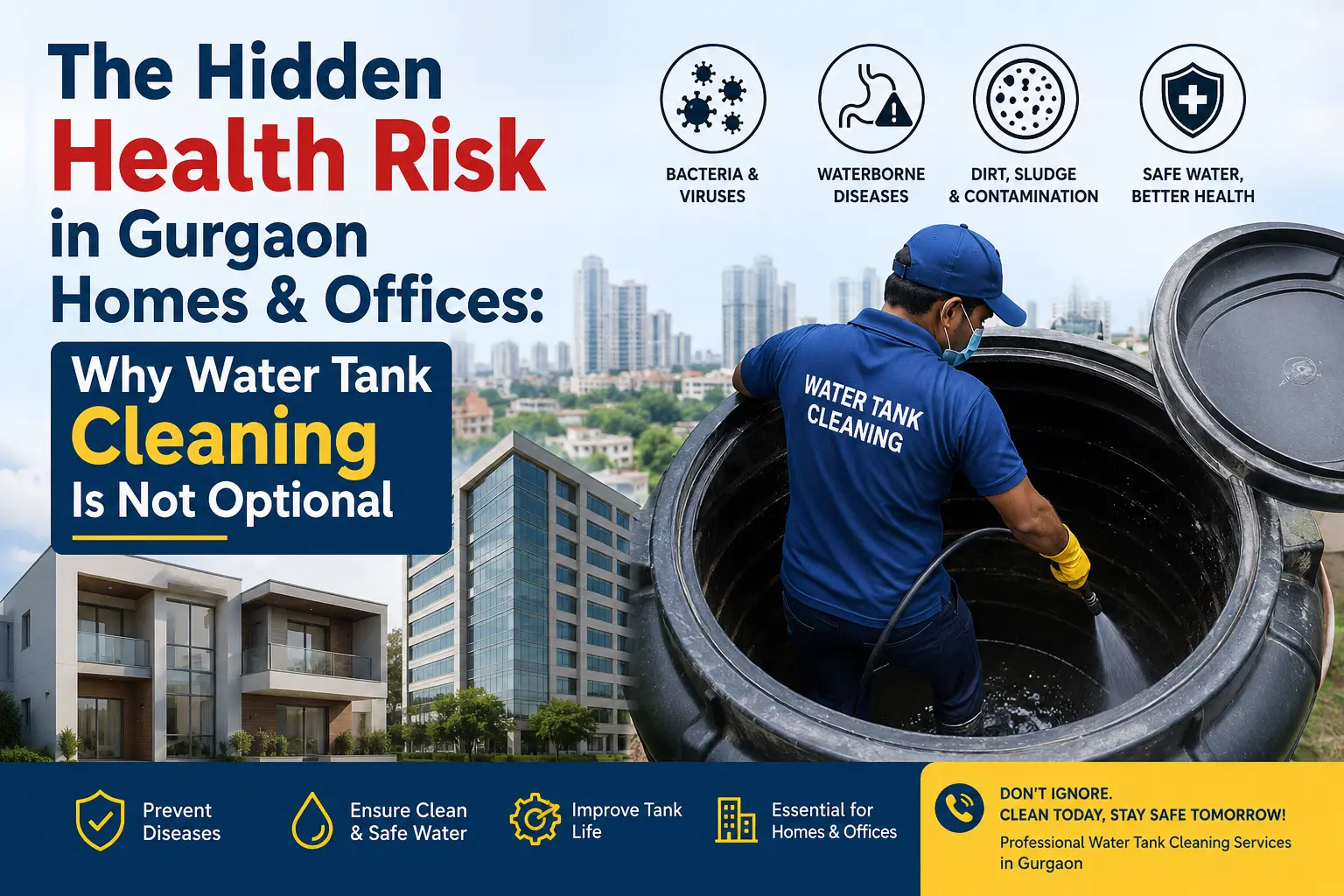
The Hidden Health Risk in Gurgaon Homes & Offices: Why Water Tank Cleaning Is Not Optional
When you think about maintaining a property in Gurgaon, your mind naturally goes toward the most highly visible tasks. You readily schedule a professional deep clean for your corporate flooring, dust off or replace the filters in your air conditioning systems before the intense heat of summer strikes, and service your kitchen or commercial-grade Reverse Osmosis (RO) water purifiers right on time.
However, there is an extremely large, critical asset located on your rooftop or deep below the ground that has a direct, profound impact on your everyday life and physical well-being—yet it consistently remains out of sight and out of mind: your water storage tank cleaning service in Gurgaon.
In a developing, dust-heavy, and hot environment like Gurugram, proper storage, sanitation, and protection of water isn't a seasonal consideration or a luxury fallback. Whether you own an independent floor in Sector 56, manage a multi-floor corporate office located in Cyber City, or oversee a sprawling high-rise residential society on the Dwarka Expressway; keeping your water storage tanks clean is an absolute essential part of managing your health, protecting your plumbing infrastructure, and securing true peace of mind.
If you haven't scheduled a professional water tank cleaning service in Gurgaon within the last six months, now is the ideal time to protect your family, employees, and property.
To realize why relying purely on downstream filters isn't enough, we must examine the stark ground reality of Gurgaon's water delivery system and uncover the hazardous ecosystem developing inside a non-cleaned tank over time.
The Actual Realm of Gurgaon's Water Delivery System
If you wish to truly understand why regular water tank cleaning in Gurgaon is critical, you need to closely look at where your water supply originates. To fulfill the city's ever-increasing water demand, properties extract and mix water from three distinct channels:
- The Gurgaon Water Supply (GWS) open source channel.
- The Yamuna River supply channel (processed through urban water treatment plants).
- High-capacity Borewells extracting immense quantities of ground water.
Distributing this blended water through a complex, rapidly aging infrastructural network presents serious localized challenges across Haryana:
High Mineral Content (Hard Water)
Haryana's ground water contains some of the highest TDS (Total Dissolved Solids) levels across India. When this water sits stagnant, heavy mineral salts like calcium and magnesium settle heavily to the bottom, forming a thick, rock-hard chemical scale on internal walls.
Suspended Silt & Infiltrated Debris
As water travels through miles of legacy piping to reach your underground tanks, it collects loose sand, iron rust flakes, grit, and organic materials. This creates an unrelenting accumulation of heavy mud and debris month after month.
Rapid Stagnation Under Intense Heat
Intermittent municipal schedules cause water to sit completely stagnant in dark tanks for long durations. Combined with Gurgaon's blistering summer temperatures, it forms a high-incubation chamber for volatile biological threats.
The Hidden Danger of Water Tanks: Impact on Health & Property
Many homeowners assume that because their overhead or underground tank features a closed lid, the water inside stays pristine indefinitely. Unfortunately, if you have not completely opened and inspected the inside of your water tank in the last six months, a dangerous environment is likely developing:
1. Biofilm and Rapid Algae Growth
The moment intense sunlight hits a minor crack or unsealed flap on a standard PVC tank, or when ambient water temperatures exceed 30 degrees Celsius, rapid algae colonization begins. This algae adheres to the structure, establishing a sticky, slimy layer known as biofilm. This biofilm acts as an impenetrable shield and food reservoir for harmful pathogens, neutralizing the microscopic residual chlorine sent by municipal treatment plants.
2. Volatile Bacterial Breeding Grounds
A neglected storage framework presents an ongoing, active threat from severe waterborne conditions. Unmaintained tanks offer premium breeding grounds for highly dangerous microscopic organisms like E. coli, Salmonella, and Legionella. These dangerous pathogenetic strains are readily introduced into the main water column whenever the heavy sediment layer at the bottom is physically disturbed during high-pressure filling cycles.
3. Pests, Airborne Storms, and Intruders
Due to the aggressive, severe dust storms (Andhi) that routinely slam Gurgaon, structural tank lids commonly warp, crack, or get blown off entirely. Once exposed to the elements, it takes only days for vectors like mosquitoes (including those carrying Dengue and Chikungunya) to establish breeding patterns. Unsecured structures also invite birds, rodents, and cockroaches, leading to severe biological contamination that can make an entire family or corporate workforce violently ill.
Crucial Ground Reality: When you brush your teeth, wash your face, or rinse fresh produce with contaminated water from an unmaintained tank, you are directly exposing your system to these exact biological pathogens.
Why You Shouldn't Solely Rely on Your RO Purifier
A classic counter-argument from property managers and residents is: "We route all our drinking water through multi-stage RO/UV purifiers, so what difference does a dirty tank make?" Relying strictly on a localized point-of-use filter while keeping a highly contaminated main tank is a dangerous, flawed strategy for two structural reasons:
- The Point-of-Use Limitation: Purification units only treat water consumed for drinking and cooking. You remain completely exposed to bacterial loads while showering, washing hands, and brushing teeth. Bathing in water thick with suspended silt and high bacterial activity strips natural moisture barriers, frequently driving chronic skin irritation, acne breakouts, dandruff, and accelerated hair fall across Delhi-NCR.
- Premature Mechanical and Plumbing Failure: Pumping heavy mud, abrasive silt, and coarse scaling out of your overhead tank forces your household appliances to over-process material. This directly chokes expensive kitchen RO membranes, leading to premature filter failure and high replacement costs. Furthermore, it chokes luxury bathroom fixtures, internal geysers, and pipelines with rust and calcified blockages, causing restricted flow or hidden pipe bursts behind expensive tiling.
The Professional Advantage: AKS Facilities 6-Stage Process
Attempting to clean a deep underground or high-rise overhead tank using domestic help or a local handyman armed with only a broom and a standard bucket of bleach is highly ineffective. This traditional manual approach fails to eliminate stubborn biofilm, misses microscopic spores, and often introduces toxic chemical over-concentrations into your domestic system.
AKS Facilities follows a scientifically designed 6-stage water tank cleaning and disinfection process that removes sludge, algae, biofilm and harmful bacteria before safely restoring your water supply.
Using specialized, high-discharge submersible pumps to rapidly draw out stagnant water volumes without causing messy flooding across your terrace or basement areas.
High-vacuum industrial sludge extractors suck out the dense, heavy layers of accumulated mud, sand, grit, and decayed organic elements settled tightly at the bottom.
Heavy-duty, high-pressure industrial water jets are used to thoroughly strip away stubborn biological slime, algae spots, and deep chemical scale formations from every square inch of walls and ceilings without damaging structural integrity.
The final remnants of contaminated wash-water, suspended dirt specks, and loose scale particles are completely vacuumed clear, leaving internal surfaces bone-dry and spotless.
A fully certified, non-toxic, food-grade anti-bacterial sanitizing spray is systematically applied across all internal surfaces to safely eliminate microscopic bacterial spores and prevent rapid re-colonization.
An advanced final stage involving localized ultraviolet radiation exposure to neutralize any lingering floating pathogens inside the tank structure, ensuring the tank is fully sterilized before refilling.
Want to understand every stage in detail? Read our complete guide on the professional 6-stage water tank cleaning process.
Customized Solutions For Gurgaon's Diverse Properties
| Property Classification | Key Hubs & Locations | Core Regional Water Challenges | Targeted Cleaning Action |
|---|---|---|---|
| Residential Apartments & Floors | Sushant Lok, Sohna Road, Sector 56 | Multi-tiered plumbing loops (underground to roof transfers) double the rate of heavy sediment buildup. | Bi-annual clinical mechanized sterilization to secure tap safety and maintain constant pressure. |
| Commercial Buildings & IT Parks | Cyber City, Udyog Vihar, Golf Course Ext. | Massive daily intake, extensive compliance needs, employee safety risks, and operational disruption limits. | Quarterly scheduled off-peak or weekend sanitization operations to safeguard workplace compliance. |
By choosing AKS Facilities, you enlist years of industrial expertise, specialized multi-stage tools, and a background-verified, fully trained professional workforce adhering to strict international safety and environmental protocols.
Frequently Asked Questions (FAQs)
Due to the heavy mineral content of local ground water, constant reliance on external tankers, and a dust-heavy environment, we recommend professional cleaning every 6 months. If your community or society is highly dependent on unmanaged private tanker supplies, executing a quarterly maintenance cycle (every 3 to 4 months) is advised to prevent heavy mud layers from hardening.
Absolutely. Storing water in dirty environments leads to an accumulation of bacteria, heavy metals, and grit that strips away the natural sebum barrier of your scalp and skin. This triggers persistent dryness, dandruff, acne flare-ups, and severely weakens hair follicles, causing accelerated hair fall. Regular clinical sanitation eliminates these suspended irritants.
A standard residential overhead tank (approx. 1000 to 2000 liters) requires roughly 1 to 2 hours from start to finish. Massive underground commercial storage units or collective residential society reservoirs take anywhere from 4 to 8 hours, depending entirely on layout dimensions and the density of internal sludge accumulation.
Yes, completely. At AKS Facilities, our final stages include thorough industrial vacuum drying and the application of safe, non-toxic, food-grade antibacterial sanitizers. Once our final rinse and drying cycles conclude, your system is instantly safe to refill and deploy for all daily activities.
Yes, significantly. Removing heavy mud, coarse sand, and iron rust at the main storage tank level drastically cuts down the particulate load entering your kitchen line. This stops your kitchen RO pre-filters and delicate internal carbon membranes from clogging prematurely, lowering your appliance repair and filter replacement costs significantly.
Related Water Tank Cleaning Resources
- Professional Water Tank Cleaning Services in Gurgaon
- 6-Stage Water Tank Cleaning & Disinfection Process
Get in touch with Gurgaon's premium mechanized facility management experts.
Call AKS Facilities: 8800552456Residential, Commercial & Industrial Water Tank Cleaning & Complete Disinfection Services