

The Silent Home-Wrecker: A Real-World Guide to Spotting, Preventing, and Eliminating Termites
Your home is likely your biggest financial investment. Yet, every year, termites cause billions of dollars in structural damage globally—damage that standard homeowners insurance almost never covers.
The biggest challenge with termites is that they don’t invite themselves in with a grand entrance. They eat through wood from the inside out, completely hidden behind your drywall, under your flooring, and beneath your foundation.
By understanding exactly what to look for, why termites choose your property, and how to stop them, you can protect your home before major structural repairs become necessary.
The signs of termite damage are often difficult to detect because termites are shy insects that prefer to stay hidden. They silently feed inside wooden structures without being noticed. There are many ways to reduce the chances of termite infestation; however, if you suspect an issue, take a flashlight and a flat-head screwdriver and inspect your home for these four major indicators.
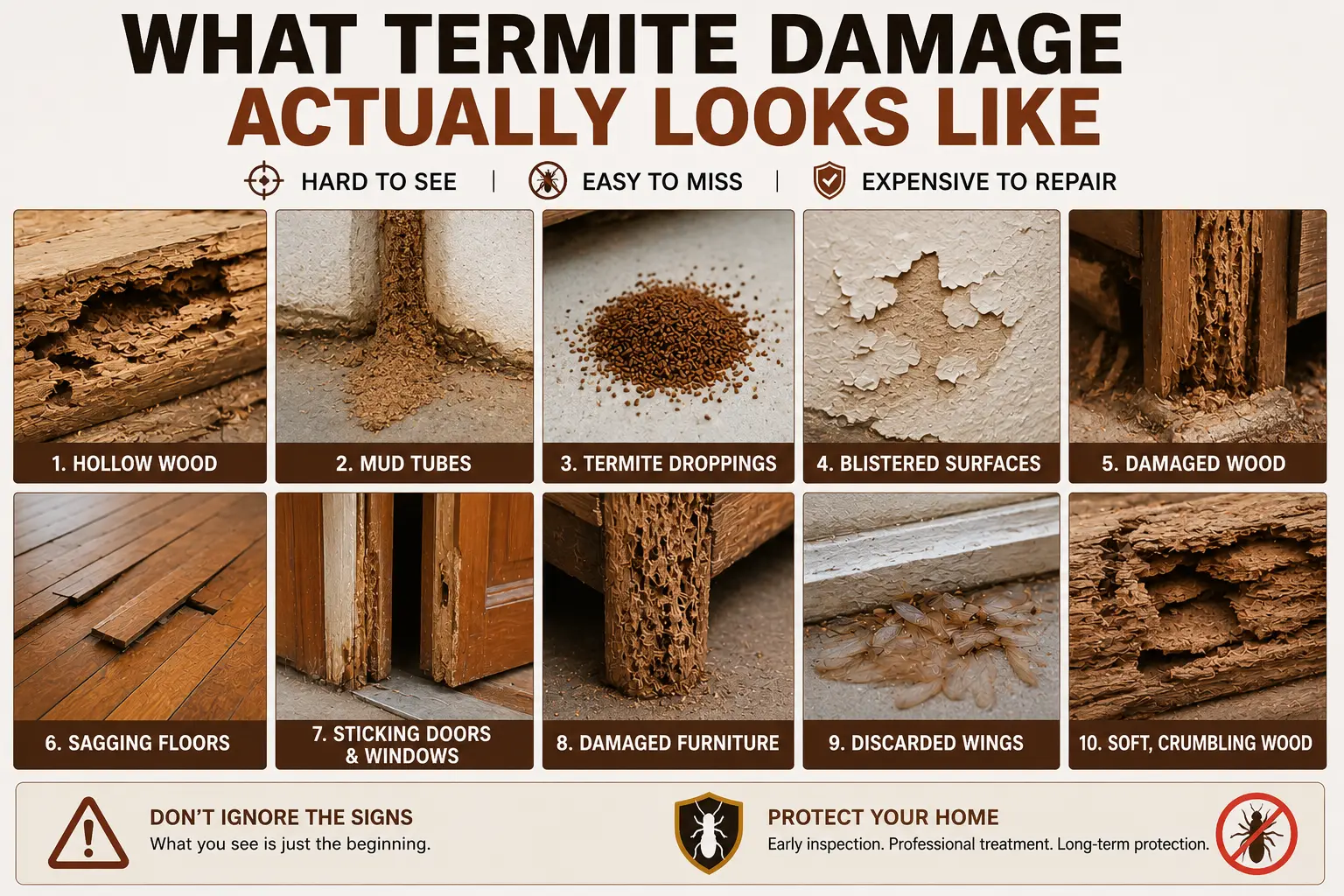
Four Major Indicators of Termite Activity
1. The "Hollow Wood" Test
Healthy wood feels solid and resists pressure. Wood damaged by termites becomes hollow from the inside.
How to Check:- Inspect timber in your basement, crawl space, furniture, wooden doors, windows, skirting, and wall trims.
- Tap the wood using the handle of a screwdriver.
- If the wood sounds hollow or easily breaks when pressed, termites may have already eaten away the internal structure.
2. Mud Tubes
Subterranean termites require constant moisture to survive. They build mud tubes that allow them to travel safely between their underground colony and the wooden parts of your home.
Where to Look:- Foundation walls & concrete surfaces
- Support columns & plumbing pipes
- Crawl spaces & basement walls
Note: Mud tubes usually appear as thin brown lines, often smaller than the width of a pencil. If you gently break one open and find creamy-white termites inside, you likely have an active termite infestation.
3. Termite Droppings (Drywood Frass)
Drywood termites create tiny holes known as "kick-out holes" to push waste out of the wood while tunneling.
Common Locations:Window sills, wooden flooring, cabinets, furniture, and near wooden beams. The droppings resemble tiny piles of sawdust, sand, or black pepper. When viewed closely, each pellet has six distinct sides.
4. Hidden Structural Damage
Because termites create moisture while feeding, termite damage often resembles water damage.
Look for signs such as:- Blistered wooden flooring & buckled laminate
- Sagging ceilings & bubbling paint
- Hollow doors & cracked drywall
- Windows and doors becoming difficult to close/open smoothly
For high-rise residential apartments prone to seasonal infestations, read our deep dive on Why Gurgaon's Monsoon is Bringing a Termite Tsunami to New Sector High-Rises.
Why Do Termites Choose Certain Homes?
Termites don't invade homes by accident. They look for two essential things: Cellulose (their food source) and Moisture (their survival requirement). Understanding these conditions helps make your property less attractive to termites.
Primary Environmental Triggers:
- High Soil Moisture: Broken outdoor taps, leaking pipes, clogged gutters, poor drainage, or landscaping that allows rainwater to collect near your foundation creates the perfect environment for subterranean termites.
- Direct Wood-to-Ground Contact: Wooden fence posts, decks, door frames, garden sleepers, and wooden structures touching the soil provide termites with hidden access into your home. Learn how to prevent this by reviewing our guide on how can you protect your home from termites in Gurgaon.
- Improper Landscaping: Firewood stacked against exterior walls, thick mulch, untreated timber, and excessive organic debris provide both food and moisture for termite colonies.
How to Prevent Termite Infestation
1. Fix Moisture Problems
- Repair leaking plumbing lines.
- Clean blocked roof gutters regularly.
- Extend downspouts 3–4 feet away from the foundation.
- Improve drainage around the entire property.
2. Reduce Wood Contact
- Keep wooden structures completely off the soil.
- Store firewood at least 20 feet away from the house.
- Leave a visible concrete foundation gap between the soil and siding.
Professional External Protection & Baiting Systems
Professional liquid termiticide treatments are applied around the property's foundation to create an invisible protective barrier. As termites pass through the treated zone, they carry the product back to the colony, helping eliminate thousands of termites instead of just the visible ones. For long-term protection, learn more about what is a termites worst enemy and professional anti-termite methods.
DIY vs Professional Termite Treatment
Many hardware stores sell DIY termite sprays and chemicals. While these products may kill a few visible termites, they cannot reach the thousands hidden inside walls, foundations, furniture, or underground colonies. Spot treatments automotive-grade sprays rarely solve the root problem.
If you suspect an active termite infestation, your property should always be inspected and treated by a licensed pest control professional using commercial-grade equipment and approved termiticides. Professional termite treatment helps protect your property's structural integrity and significantly reduces the risk of costly repairs.
AKS Facilities – Professional Termite Control Services
Protect your home or commercial property with AKS Facilities' professional termite control services. We provide safe, effective, and long-lasting termite treatment solutions across residential and commercial ecosystems.
Sectors We Serve:
- Residential Homes, Apartments & Villas
- Offices & Commercial Buildings
- Warehouses, Restaurants & Hotels
- Schools, Hospitals & Industrial Facilities
Our Specialized Services:
- Pre & Post-Construction Anti-Termite Treatment
- Wooden Furniture & Soil Termite Treatment
- Drill & Inject / Chemical Barrier Treatment
- Annual Termite Maintenance Plans (AMC)
Why Choose AKS Facilities?
✔ Government Approved Chemicals | ✔ Trained & Verified Technicians | ✔ Advanced Professional Equipment | ✔ Safe for Families & Pets (After Drying) | ✔ Transparent Pricing
Our Core Service Locations: Delhi, New Delhi, Gurgaon (Gurugram), Noida, Greater Noida, Ghaziabad, Faridabad, Delhi NCR, and Mumbai.
If you notice any signs of termite activity, secure your structural asset immediately. Explore our dedicated Termite Control Service in Gurgaon or our broader Pest Control Services in Gurgaon framework.
Book an Inspection: 8800552456