Table of Contents
- Why Rainwater Makes Gurgaon Glass Dirtier
- The Science of Hard Water Stains
- Understanding TDS & Gurgaon Groundwater
- Silica Scaling Explained
- How AQI & Pollution Damage Facade Glass
- Commercial Building Maintenance Challenges
- Before vs After Facade Cleaning Problems
- DIY vs Professional Glass Restoration
- Deionized Water Cleaning Technology
- Best Facade Cleaning Frequency
- Commercial Building Pain Points
- Why AKS Facilities Is Trusted
- Frequently Asked Questions
Monsoon rain is usually associated with freshness, cleaner surroundings, and sparkling building exteriors. But if you manage a corporate office, commercial tower, hotel, mall, hospital, or residential high-rise in Gurgaon, you have probably noticed something frustrating — your building glass still looks dirty even after heavy rain.
Instead of looking crystal clear, the facade glass often appears cloudy, streaky, patchy, or covered with stubborn white spots. In many cases, the glass looks even worse after rain than before it.
This is not simply because the rainwater is dirty.
The real problem involves a combination of Gurgaon’s hard groundwater chemistry, high TDS levels, silica-rich mineral deposits, construction dust, industrial pollution, vehicle emissions, alkaline runoff, and poor facade maintenance practices.
Over time, these deposits reduce facade transparency, damage expensive architectural glass systems, affect brand image, and increase long-term maintenance costs.
This is why professional facade cleaning services in Gurgaon are now essential for modern commercial buildings.
The Science Behind Why Rainwater Makes Glass Dirtier
Most people assume rainwater is naturally pure. Scientifically, this is incorrect — especially in highly urbanized environments like Gurgaon.
Before rainwater even touches your building, it already contains:
- Dust particles
- Carbon emissions
- Industrial pollutants
- Sulfur compounds
- Nitrogen oxides
- Construction debris
- Silica particles
- Airborne minerals
Once rainwater lands on facade glass, Gurgaon’s heat and humidity rapidly evaporate the water. However, evaporation leaves behind concentrated mineral residues.
These residues create:
- Hard water stains
- Rainwater spots
- White calcium marks
- Silica scaling
- Cloudy facade haze
- Permanent etching
The result is glass that looks dirtier after rain instead of cleaner.
The Chemistry of Hard Water Stains
One of the biggest causes of facade staining in Gurgaon is hard water.
Hard water contains elevated concentrations of:
- Calcium ions
- Magnesium ions
- Bicarbonates
- Lime compounds
- Silica minerals
- Total dissolved solids (TDS)
When hard water evaporates on glass surfaces, dissolved minerals remain behind as deposits.
How Hard Water Stains Form
- Rainwater or cleaning water lands on glass
- Water evaporates rapidly
- Minerals stay behind
- Deposits crystallize on the surface
- Repeated exposure thickens the buildup
Over time, these deposits chemically bond with facade glass and become difficult to remove.
Unlike ordinary dust, hard water stains cannot be cleaned effectively with simple cloth wiping.
Understanding Gurgaon Groundwater & TDS Levels
Gurgaon faces severe groundwater hardness issues.
Many areas experience:
- Very high TDS levels
- High alkalinity
- Elevated mineral concentration
- Silica-rich underground water
In several commercial zones, TDS levels can exceed 2000–5000 ppm depending on the source.
Higher TDS means:
- More mineral deposits
- Faster scaling
- Increased white spotting
- More severe facade staining
This is one reason why buildings near construction-heavy zones like Golf Course Extension Road, Sohna Road, Cyber City, Udyog Vihar, and New Gurgaon experience accelerated facade contamination.
What Is Silica Scaling?
Silica scaling is one of the most dangerous forms of facade contamination.
Silica (SiO₂) is naturally present in:
- Groundwater
- Construction dust
- Cement particles
- Sand residue
- Airborne pollutants
When silica-rich water repeatedly dries on glass surfaces, the silica chemically fuses with the glass itself.
This creates:
- Permanent cloudy appearance
- Rough glass texture
- Distorted sunlight reflection
- Etching marks
- Reduced transparency
Unlike temporary dirt, silica scaling physically damages the glass surface.
If ignored too long, complete glass replacement may become necessary.
How Gurgaon AQI & Pollution Damage Facade Glass
Gurgaon regularly experiences poor AQI levels due to:
- Construction activity
- Heavy traffic
- Industrial pollution
- Dust storms
- Vehicular emissions
- Concrete debris
PM2.5 and PM10 particles continuously settle on building exteriors.
When rainwater combines with these pollutants:
- Sticky residue forms
- Dust bonds with minerals
- Muddy streaks appear
- Acidic contaminants attack glass
- Facade clarity decreases
Buildings near highways, metro routes, and construction zones accumulate contamination significantly faster.
Commercial Building Maintenance Challenges in Gurgaon
Commercial properties face unique facade maintenance problems.
High-Rise Accessibility
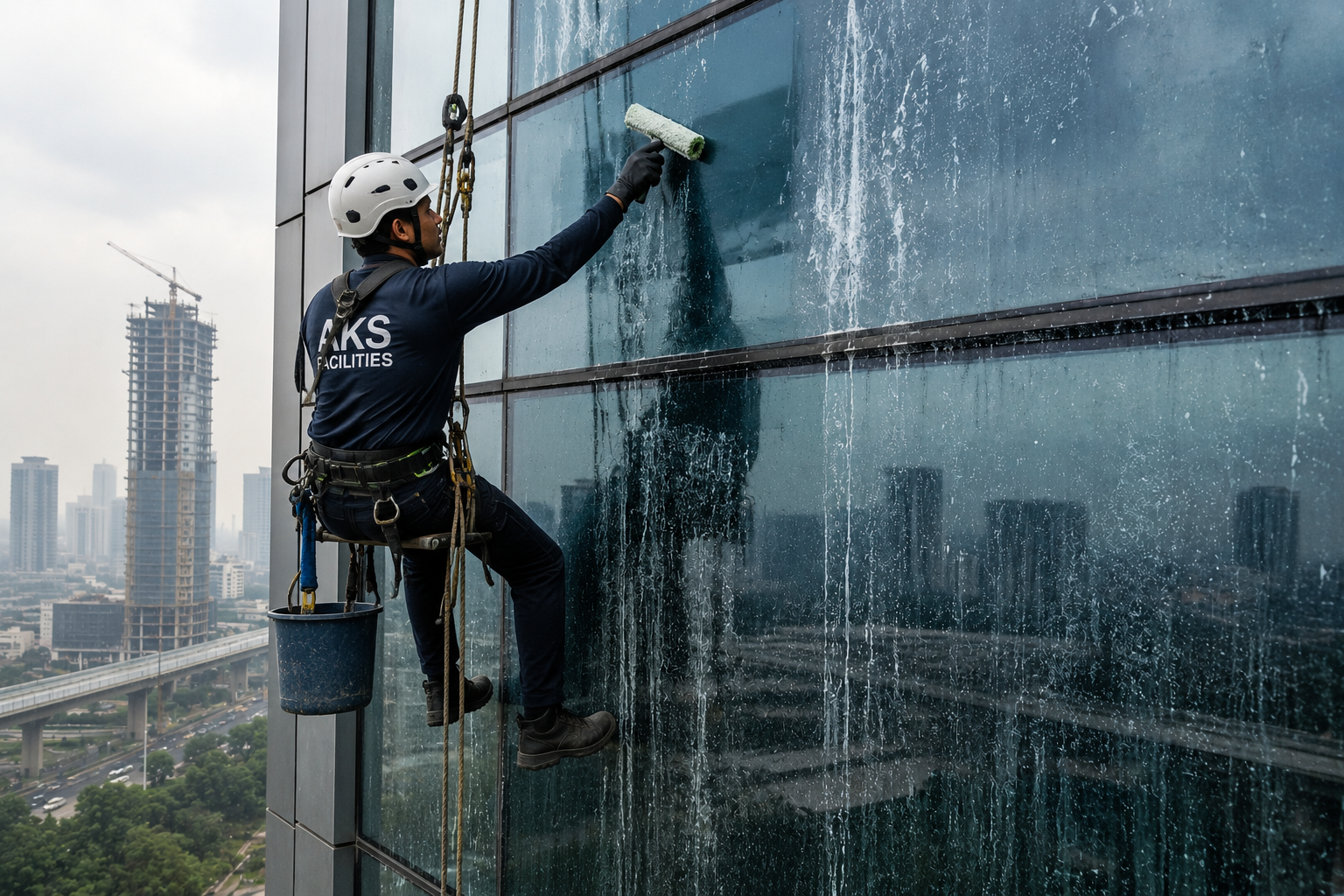
Cleaning tall towers safely requires rope access systems, gondolas, and trained technicians.
Constant Dust Exposure
Open construction projects continuously deposit fine dust on facade glass.
Hard Water Cleaning Damage
Improper cleaning using mineral-rich water worsens staining instead of improving clarity.
Tenant Complaints
Dirty facades negatively affect office image, tenant satisfaction, and visitor perception.
Before vs After Professional Facade Cleaning
| Before Professional Cleaning | After Professional Restoration |
|---|---|
| Cloudy facade appearance | Crystal clear reflective glass |
| Hard water stains visible | Mineral deposits removed |
| Dust streaks after rain | Uniform spotless finish |
| Poor natural lighting | Improved daylight penetration |
| Negative building image | Premium commercial appearance |
| Accelerated glass damage | Extended facade lifespan |
Why DIY Glass Cleaning Usually Fails
Vinegar Cleaning
While vinegar can dissolve mild calcium deposits temporarily, it cannot remove silica scaling or deep mineral bonding.
Soap & Detergents
Regular cleaners often smear deposits across the surface instead of removing them.
Abrasive Scrubbing
Steel wool, rough pads, and blades can permanently scratch architectural glass coatings.
Using Hard Water for Cleaning
Many local cleaners unknowingly use hard groundwater, which creates new mineral stains immediately after cleaning.
Professional Facade Cleaning & Glass Restoration Process
1. Glass Inspection
Experts identify:
- Hard water stains
- Silica scaling
- Glass scratches
- Sealant damage
- Acidic etching
- Surface contamination
2. Descaling Treatment
Industrial-grade non-abrasive compounds dissolve mineral deposits safely.
3. Deionized Water Technology
Professional companies use deionized water systems with:
- Zero TDS
- No calcium
- No magnesium
- No silica
This allows water to dry completely spotless without leaving marks.
4. Rope Access Facade Cleaning
High-rise towers require trained rope access professionals using:
- Safety harnesses
- Gondola systems
- Industrial anchors
- Certified cleaning equipment
5. Protective Hydrophobic Coating
Protective coatings reduce future:
- Dust adhesion
- Mineral bonding
- Rainwater spotting
- Glass contamination
Recommended Facade Cleaning Frequency
| Building Type | Recommended Cleaning Frequency |
|---|---|
| Commercial Towers | Every 3–4 Months |
| Hotels & Malls | Every 2–3 Months |
| Residential High-Rises | Every 4–6 Months |
| Buildings Near Construction | Monthly or Bi-Monthly |
| Corporate Offices | Quarterly Maintenance |
Commercial Building Pain Points Caused by Dirty Facades
- Reduced premium appearance
- Loss of tenant satisfaction
- Lower property value perception
- Negative client impressions
- Reduced natural daylight
- Higher long-term glass replacement costs
- Brand image deterioration
- Increased maintenance complexity
Why AKS Facilities Is Trusted for Facade Cleaning in Gurgaon
AKS Facilities provides professional facade cleaning and restoration solutions for:
- Commercial buildings
- Corporate offices
- Hotels
- Shopping malls
- Residential societies
- Industrial buildings
- High-rise towers
Related Professional Services
Protect Your Facade Glass Before Permanent Damage Begins
Professional facade cleaning, silica scaling removal, hard water stain treatment & commercial glass restoration services in Gurgaon.
Book Inspection TodayFrequently Asked Questions
Why does facade glass look cloudy even after rain?
Cloudiness is usually caused by mineral deposits, silica scaling, pollution residue, and hard water stains left behind after rainwater evaporates.
What are hard water stains on commercial glass?
Hard water stains are mineral residues containing calcium and magnesium that remain on glass surfaces after water evaporation.
What is silica scaling?
Silica scaling occurs when silica-rich water chemically bonds with glass surfaces and causes permanent cloudy etching.
Can hard water stains permanently damage facade glass?
Yes. Long-term mineral exposure can permanently etch glass and reduce transparency if untreated.
Why is Gurgaon facade glass more difficult to maintain?
High pollution, hard groundwater, dust, construction activity, and elevated TDS levels accelerate facade contamination.
What is deionized water cleaning?
Deionized water contains zero minerals or dissolved solids, allowing spotless drying without residue.
How often should commercial buildings schedule facade cleaning?
Most Gurgaon commercial buildings should undergo facade cleaning every 3–6 months depending on environmental exposure.
Is rope access facade cleaning safe?
Yes. Certified rope access technicians use industrial safety systems and professional equipment for secure high-rise cleaning.