

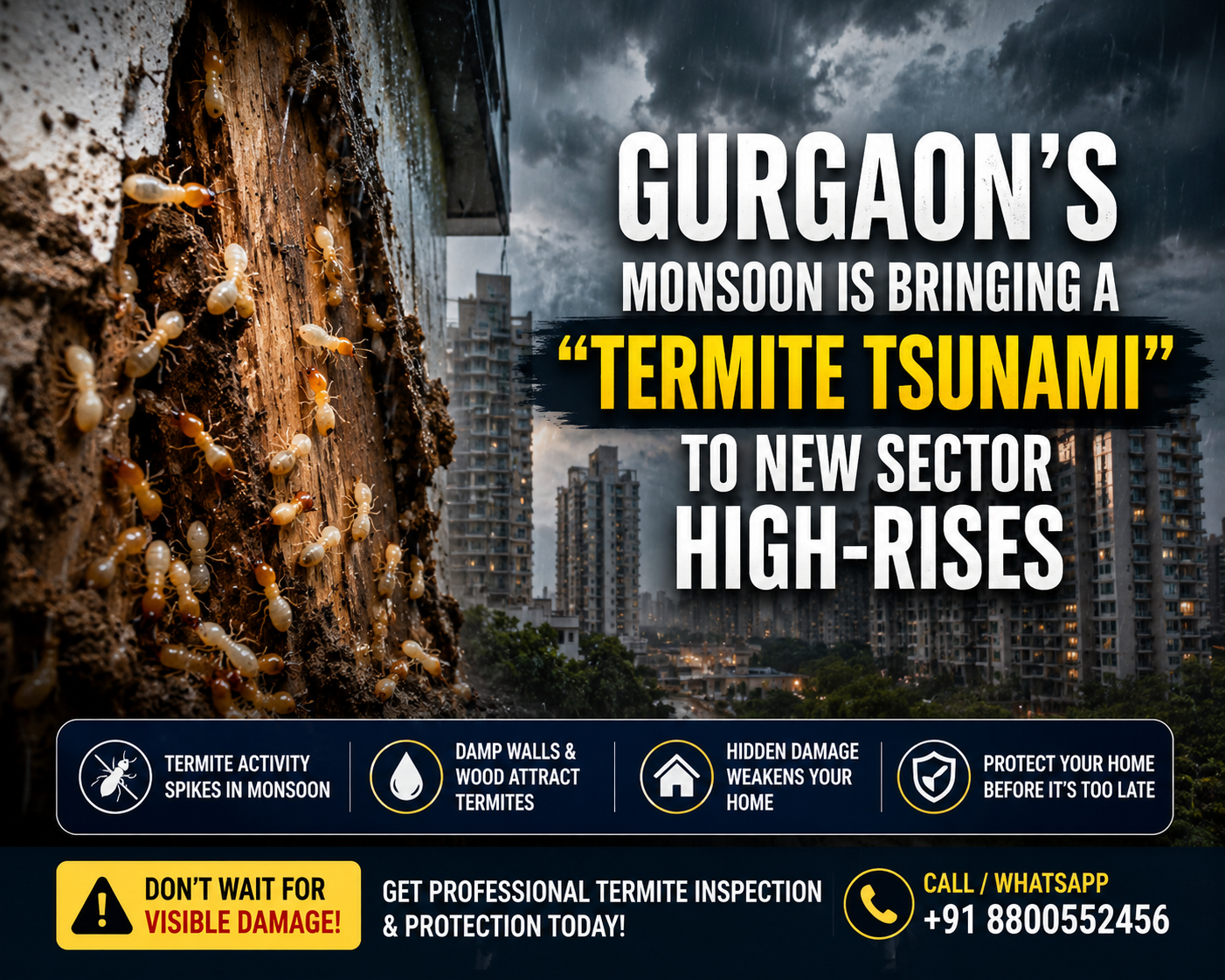
So here come the rains. The city's relieved, traffic's predictably doubled and the air feels like you're trying to breathe through a wet dishcloth. At least it's not 44 degrees C any longer. That's good.
Still, here's the unspoken crisis in Gurgaon, the one that isn't discussed over evening drinks or family gatherings. The monsoons, aside from giving relief, awaken a dormant subterranean fury under Gurgaon's new sectors. Termites. Specifically, subterranean termites.
If you own a flat in any one of the towers peppering the Dwarka Expressway or rent space on a floor of an office building in Cyber City or Udyog Vihar, this is the prime time of the year when your property is most vulnerable. Not to water or power outages, but to the crawling critters that have made the soil beneath your building their home long before the concrete foundations were laid.
People invariably say, "But I'm on the 14th floor."
Fair enough, you think. Height offers an excellent form of natural defence, right? Termites are a ground-dwelling problem, are they not?
Not entirely.
The Hidden Subterranean Highways
Most of the land that's been developed to create the southern sectors of Gurgaon — sectors like 57, 65, 82, 102 — used to be agricultural or fallow land for decades before builders moved in. Existing subterranean colonies were living in that soil, undisturbed, for years. When construction starts, you disturb the topsoil, but you cannot get rid of the entire colony beneath. It doesn't die off, it adapts.
Interestingly enough, a modern high-rise is surprisingly good for termites. The structural vulnerabilities serve as hidden paths straight up to your property:
Plumbing Shafts
The plumbing shafts that run through each floor of your building have permanently humid microclimates.
Expansion Joints
The small gaps created to accommodate natural building settling - only need to be 0.8mm wide to accommodate the entry of a termite. Most buildings develop these within their first one or two years of construction.
Electrical Conduits
The electrical conduit channels that lie behind your drywall run from ground to the 20th floor in one continuous channel. They're hollow, they're dark, and completely undisturbed.
Added to this slight increase in outdoor humidity before the monsoon, causes the mature colonies to release winged reproductives which fly into the building through open balconies and vents, and your 14th-floor flat is not the refuge you imagined.
Related Termite Management Resources:
Residential vs. Commercial Infiltration
For residential apartments the damage done is insidious, and expensive. Materials in many high-end apartments are wood-based and are essentially a food source for termites. The first casualty is usually the modular kitchen. Behind the kitchen cabinets that lie below the sink, there's condensation which leads to a constant low-level dampness. These parts of the kitchen are not checked as regularly, and the termites start work from there.
The front of your cabinet will look perfect — lacquered, shiny, perhaps even expensive — but internally it will be hollowed out. You'll typically discover this when a shelf suddenly collapses or when you spot a mud tube running up the skirting board and decide to 'google it'.
Engineered hardwood floors also pose a problem. They're placed over concrete sub-floors, and this can create a narrow, dark space beneath them. If your flooring gives a soft springy response or seems hollow to the tread of your foot, listen to it. Walls covered with panelling which develop a bubble-like texture, resembling water damage, can be another indication of subterranean termites.
Floor to ceiling built-in wardrobes are perhaps the worst perpetrators as they are so rarely removed and examined. They can lie undiscovered for months, allowing a termite colony to feed unseen on the back panel. You only find out when you move something and the backing disintegrates, or you see mud tubes forming against the floor.
For commercial buildings, raised floor systems are common, this is that false floor that sits over your network cabling. That space beneath the false floor is cool, dry and dust filled, rarely opened unless a component fails. Termites that find their way in will eat away at the insulation of network cables and other wiring, creating electrical risks that only become apparent when a part of your server room stops working. Suddenly, it's no longer just an insect problem, it's a business continuity issue.
Partition walls in offices, made out of plasterboard with a paper facing, are another target. Paper is pure cellulose, the termite's favourite food. A small breach in one partition can cause the entire floor to be infiltrated quicker than expected by most facilities managers. In offices in Udyog Vihar that have large paper records and files, this can lead to complete data loss.
Treatment needs to be scientific!
The difference between home remedies and professional treatment is the use of a non-repellent termiticide. Termites can't detect the chemical, so they pass over the treated areas, track the chemical back to their nest, and effectively treat the entire colony including the queen.
At AKS Facilities they adopt a drill, fill and seal method of application. Structural weaknesses are identified and micro-holes are drilled at set intervals in the walls and baseboards. The termiticide is then injected into the framework, and the entry point is sealed up again.
For homes the products are odourless and safe for kids and pets, while for commercial environments the treatment is done during the night or over weekends to minimize disruption. Digital reports and proper GST invoicing are also provided.
For apartments and office buildings sharing common utility shafts and plumbing channels, an Annual Maintenance Contract with the treatment agency makes more financial sense than any individual application.
Don't wait for the termites to show up in your apartment or office.
As the monsoon continues and water begins to seep more into Gurgaon's soil, rising groundwater levels encourage termites to ascend. At this stage slow, confined infestations become rampant ones and by the time you notice a collapsing shelf, bubbling paintwork or rotting furniture, the damage is already significant.
A complimentary pre-monsoon inspection takes less than an hour and will cost you nothing; replacing your modular kitchen or rewiring a commercial office space will run into lakhs.
When it comes to the cost of treatment in Gurgaon it will depend on the size of the apartment, whether there are a lot of wooden fixtures, kitchens or wardrobes involved, and whether it is for prevention or active eradication.
For commercial offices with a high occupancy rate, monthly or quarterly treatment contracts under AMCs is a good idea and it would help reduce cost compared to emergency call outs and repairs.
The chemicals used are safe for children and pets; they are Government approved and odourless.
Questions & Answers
Cost of treatment for a flat in Gurgaon?
This will vary according to size, level of wood panelling or modular furniture required and whether it's prevention or active eradication. We provide a customized quote per layout and will not give a generalized price without seeing your apartment.
How often should a commercial establishment have pest control treatments?
Monthly/Quarterly (under an AMC) treatments are ideal for offices where there is a lot of movement. Early detection of vectors of entry is more cost effective than repairing damage.
Are the chemicals used safe for children/pets?
The chemical formulations used are government approved, low toxicity, odourless and formulated for indoor use. There are no fumes or residues post treatment.
How long does the treatment in a high rise last?
A deep-injection treatment has a life span of three to five years. However, because of the shared shafts and common structural elements of a high-rise building, an annual preventive check is still recommended.
Can termites spread between two flats in the same floor?
Yes, and it can occur faster than residents realize. Shared conduits, expansion joints and brickwork are often enough to offer an active colony access to several other flats.